
Rare Nusantara Dishes You Won’t Find on a Typical Menu


Ask most people to name a Nusantara dish and the answer arrives fast: satay, rendang, maybe laksa if they’re thinking a little further afield. All three deserve their reputation. None of them are remotely the whole story. The Nusantara region’s actual culinary range is vastly wider than what’s made it onto the average menu, and most of what’s been left out isn’t obscure by accident — it’s often more labour-intensive, harder to standardise, or simply less familiar to a market that’s only ever been offered the same handful of greatest hits.
Why the Same Six Dishes Dominate Every Menu
Restaurants gravitate toward what’s already recognisable, for entirely reasonable commercial reasons — a diner is far more likely to order something they’ve heard of than something they haven’t, so menus tend to consolidate around the same safe handful of dishes over time. The effect compounds: the more often satay and rendang appear on menus, the more they become “what Nusantara food is” in most people’s minds, and the less room there is for anything else to break through. It’s a self-reinforcing loop, and it means a genuinely rich culinary tradition gets represented, in most settings, by a fraction of what it actually contains.
Tulang Merah: The Dish Built From What Was Left Over
Tulang merah — literally “red bones” — is a dish with a genuinely practical origin story. Created in the 1950s by Abdul Kadir, it takes marrow, sinew and tendon, cuts of meat that were historically cheaper and less desirable, and transforms them through a rich, spicy red gravy into something far more than the sum of its parts. It’s not a refined dish in the polished, restaurant-plating sense — it’s a dish born from resourcefulness, from making the most of what was available rather than what was premium. That history is part of what makes it worth seeking out: it represents a different, less-told side of Nusantara cooking than the dishes built to impress.
Rawon: The Black Soup Most Menus Skip Entirely
Rawon is an East Javanese beef soup, deep black in colour from kluwak — the fermented seed of the keluak fruit — with a flavour that’s earthy, faintly nutty and unlike almost anything else on a typical Nusantara menu. It rarely appears outside of specifically Indonesian or Javanese-focused kitchens, partly because kluwak itself needs careful preparation to remove its natural toxicity before it’s safe to cook with, which raises the bar for any kitchen deciding whether to take it on. Where it does appear, it’s often reworked into something more contemporary — a rawon risotto, for instance, folding the traditional black broth into a creamy Italian base — a reminder that “traditional” and “static” aren’t the same thing, and that these dishes are still being actively reinterpreted rather than simply preserved behind glass.
Nasi Ulam: A Herb Salad Doing More Work Than It Looks
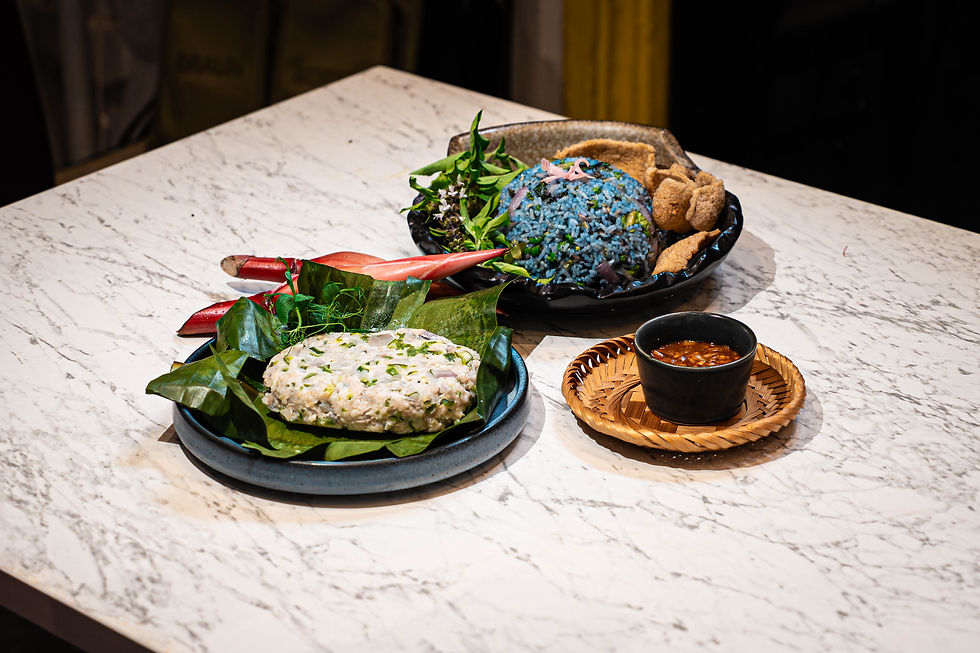
Nasi ulam looks, at first glance, like a simple herbed rice dish — but it’s built on a genuinely deep tradition of Malay botanical knowledge, mixing rice with a wide range of fresh herbs, shredded coconut and aromatics in a way that varies significantly by household and region. It’s a dish that rewards attention precisely because it looks unassuming; the complexity is in the herb combination itself, developed over generations of understanding which local plants pair well together, rather than in any elaborate cooking technique. It’s also one of the more accessible entry points into unfamiliar Nusantara dishes, being lighter and less intense than a rich, rempah-heavy main.
Why a Buffet Is the Easiest Way Into Unfamiliar Dishes
The honest barrier to trying any of these dishes isn’t availability so much as commitment — ordering a full à la carte portion of something completely unfamiliar is a bigger ask than most diners are willing to make, particularly for a dish like rawon or tulang merah with genuinely distinctive flavours that aren’t guaranteed to suit every palate. A buffet removes that barrier almost entirely. At Permata, dishes like tulang merah, rawon risotto and nasi ulam cakerawala sit within a wider spread across the Sri Paduka and Pembuka Selera stations, meaning a small, exploratory portion costs nothing beyond the choice to try it — no separate order, no commitment to a full plate of something unfamiliar, and no awkwardness in deciding, after one bite, to move on to something else.
For anyone who’s only ever encountered Nusantara food through satay and rendang, this is genuinely the easier way in — not a lecture on regional food history, just a plate with enough range on it to make the discovery low-stakes.
FAQ
What is tulang merah? A dish of beef marrow, sinew and tendon in a rich, spicy red gravy, created in the 1950s by Abdul Kadir — originally built around cheaper, less desirable cuts of meat.
Is rawon the same as rendang? No. Rendang is a dry, slow-cooked meat dish; rawon is a black beef soup from East Java, coloured and flavoured by kluwak, with a much lighter, broth-based texture.
What is nasi ulam? A herbed rice dish combining rice with a wide mix of fresh herbs, shredded coconut and aromatics — a Malay dish rooted in generations of botanical and culinary knowledge.
Why don’t more restaurants serve these dishes? Menus tend to consolidate around already-familiar dishes for commercial reasons, and some, like rawon, require specific ingredients — kluwak, in this case — that need careful preparation, raising the bar for kitchens deciding whether to take them on.
Is it easy to try several unfamiliar dishes in one sitting? Yes — this is one of the practical advantages of a wide buffet spread, allowing small, low-commitment portions of several unfamiliar dishes to be sampled in a single visit.

J'essaye Nano Banana pour la génération d'images par IA. On décrit ce qu'on veut en texte et ça génère l'image. Basé sur Gemini donc la qualité est correcte. Ça gère différents styles du réaliste à l'anime.
Me parece conveniente disponer de resultados recientes y anteriores dentro de la misma página. Esto permite consultar diferentes fechas sin cambiar constantemente de fuente. Una sección dedicada a ultimo resultados puede hacer que el proceso sea más rápido, especialmente para lectores que revisan sorteos regularmente.